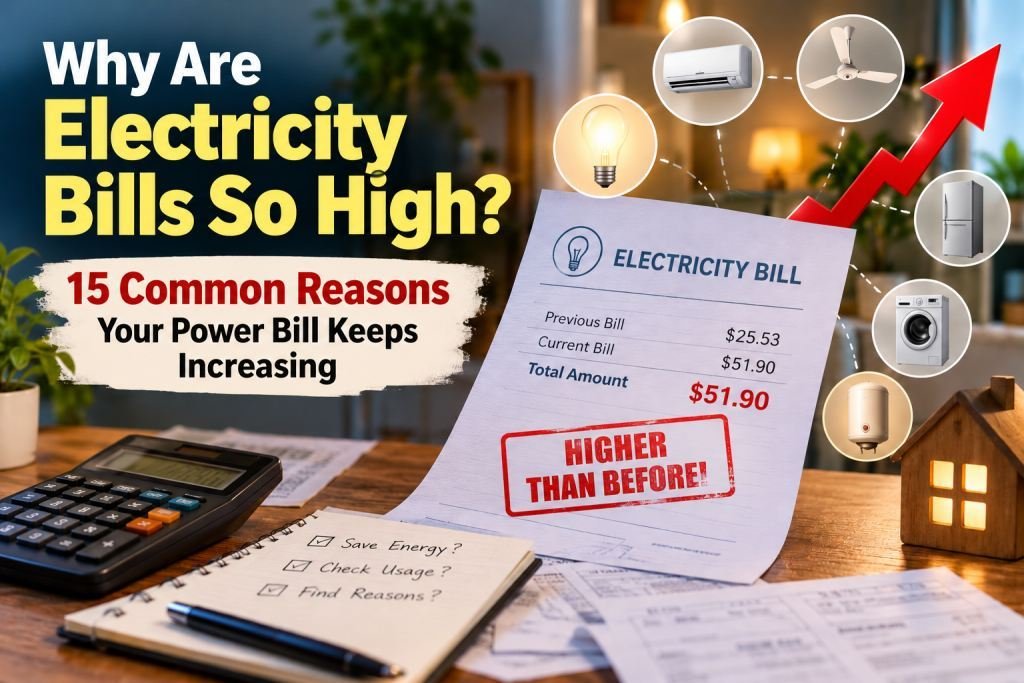
If your electricity bill seems unusually high even though your daily routine has not changed much, you are not alone. Electricity costs can rise for several reasons, and the cause is not always a single appliance or device. Your home’s energy consumption depends on the number of appliances you use, how long they operate, their efficiency, weather conditions, electricity tariffs, and even hidden power consumption from devices that appear to be switched off.
The good news is that once you understand where your electricity is going, you can often reduce your monthly bill without making major lifestyle changes.
In this article, we’ll explore why electricity bills are so high, which household appliances consume the most electricity, how to identify energy waste, and practical ways to lower your power consumption.
1. Your Air Conditioner May Be the Biggest Reason
For many homes, especially during hot weather, air conditioning is one of the largest contributors to electricity consumption.
An AC uses a compressor to remove heat from a room. The compressor can consume significant electricity, particularly when the unit operates continuously.
For example, running an AC for several hours every day can add considerably to your monthly electricity consumption.
Several factors affect AC electricity usage:
- AC capacity
- Energy efficiency rating
- Temperature setting
- Room size
- Outdoor temperature
- Insulation
- How often the compressor runs
- Condition of the filters
Setting the thermostat extremely low does not necessarily cool the room proportionally faster. It can, however, cause the system to operate for longer periods.
How to reduce AC consumption
Try keeping the temperature at a comfortable moderate setting rather than extremely low. Clean the filters regularly, keep doors and windows closed while the AC is operating, and make sure the room is properly sealed.
If you have an older AC, replacing it with a more efficient model may reduce long-term energy consumption.
2. Refrigerators Run 24 Hours a Day
Unlike many household appliances, your refrigerator operates continuously.
Even though the compressor switches on and off automatically, the refrigerator consumes electricity throughout the day.
A refrigerator can consume more energy when:
- The door is opened frequently
- The door seal is damaged
- The temperature setting is unnecessarily low
- The refrigerator is placed next to a heat source
- The condenser area is dirty
- The appliance is very old
- Hot food is repeatedly placed inside
A damaged door gasket is particularly easy to overlook. If warm air continuously enters the refrigerator, the compressor may need to run more frequently.
Simple refrigerator energy-saving tips
Check whether the door closes tightly. Avoid leaving the door open for long periods, allow adequate ventilation around the appliance, and maintain an appropriate temperature.
3. Water Heaters Can Consume a Lot of Electricity
Electric water heaters are another common source of high electricity consumption.
Heating water requires substantial energy because electricity is being converted into heat.
If your water heater operates for long periods every day, its contribution to the monthly electricity bill can become significant.
A common mistake is leaving the heater switched on much longer than necessary.
Instead, heat water when required and switch the appliance off afterward.
You can also investigate whether the heater’s thermostat is set unnecessarily high.
4. Washing Machines and Dryers Add Up
A washing machine may not consume as much electricity as an AC, but frequent use can contribute to your total consumption.
Electricity usage depends on:
- Wash temperature
- Cycle duration
- Load size
- Washing frequency
- Appliance efficiency
If your washing machine has a heating function, hot-water cycles generally require more energy than cold-water washing.
Electric clothes dryers can also consume considerable electricity because they generate heat for drying.
Whenever practical, air-drying clothes can eliminate this electricity consumption altogether.
5. Old Appliances May Be Inefficient
One of the reasons your electricity bill may increase gradually is the age of your appliances.
Older refrigerators, air conditioners, pumps, fans, televisions, and other appliances may use more electricity than newer energy-efficient models.
An appliance that still works perfectly is not necessarily an efficient appliance.
Suppose an old appliance consumes significantly more electricity than a modern equivalent. Over several years, the additional energy cost can become substantial.
Before replacing anything, however, compare:
Purchase cost + expected energy savings + expected lifespan
Replacing every old appliance immediately isn’t always financially sensible. The biggest energy users should generally receive the most attention.
6. Standby Power Is Real
Many electronic devices continue consuming a small amount of electricity even when you aren’t actively using them.
This is often called standby power or phantom load.
Examples include:
- Televisions
- Set-top boxes
- Gaming consoles
- Wi-Fi routers
- Computer equipment
- Speakers
- Printers
- Chargers
- Smart devices
One device may consume very little, but dozens of devices operating continuously can add up.
For example, equipment that remains connected 24 hours a day can consume electricity even when it appears inactive.
What can you do?
Turn off devices completely when appropriate. For groups of electronics, a power strip with a physical switch can make it easier to disconnect multiple devices.
However, some equipment—such as networking equipment or security systems—may need to remain powered continuously.
7. Fans and Lights Still Matter
LED lighting is considerably more efficient than older incandescent lighting, but lighting still contributes to total consumption.
Similarly, fans generally use less electricity than air conditioners, but running multiple fans continuously will still increase energy consumption.
A simple habit can make a difference:
Turn off lights and fans when leaving a room.
You can also use natural daylight whenever practical.
8. Your Electricity Tariff May Have Changed
Sometimes your electricity consumption has not increased dramatically, but your bill is still higher.
Why?
Because your electricity bill is affected not only by the number of units consumed but also by the applicable tariff structure and other charges.
Depending on your electricity provider and location, your bill may include components such as:
- Energy charges
- Fixed charges
- Taxes
- Electricity duty
- Fuel-related adjustments
- Other regulatory charges
Some electricity tariffs also use slabs, meaning the effective rate can change as consumption increases.
This is why consuming slightly more electricity can sometimes have a larger impact on the final bill than expected.
Always check your current tariff and compare it with previous bills.
9. Your AC Temperature Setting Matters
There is an important difference between making a room comfortable and trying to make it extremely cold.
The lower the desired indoor temperature relative to the outdoor environment, the harder the AC may need to work.
For example, during very hot weather, setting an AC dramatically lower than necessary can increase operating time.
Instead:
- Set a comfortable temperature.
- Keep windows and doors closed.
- Use curtains or blinds to reduce direct sunlight.
- Clean AC filters.
- Ensure outdoor airflow around the AC unit.
- Avoid unnecessarily cooling unoccupied rooms.
These simple changes can reduce wasted cooling.
10. Poor Insulation Can Increase Cooling Costs
Imagine pouring water into a bucket with a hole in it.
You can keep adding water, but much of it escapes.
A poorly insulated room can behave similarly with cooling.
Heat enters through:
- Windows
- Doors
- Roofs
- Exterior walls
- Gaps around doors and windows
If a room heats up quickly, the AC may have to operate longer to maintain the desired temperature.
Curtains, reflective window treatments, weather stripping, shading, and improved insulation can help reduce unwanted heat transfer.
This can be particularly useful for rooms exposed to strong afternoon sunlight.
11. Your Water Pump May Be Consuming More Than Expected
Water pumps are sometimes overlooked when investigating electricity consumption.
A pump can consume substantial electricity depending on its motor size and operating time.
Potential problems include:
- Pump running longer than necessary
- Water leakage
- Faulty float switches
- Poor plumbing
- An inefficient motor
- Pump cycling unnecessarily
If your pump seems to operate much longer than it used to, investigate the reason rather than simply accepting the increased electricity consumption.
12. Computers and Work-From-Home Equipment
Working from home can increase electricity consumption because computers and related equipment may operate for many hours.
A typical setup could include:
- Desktop computer
- Monitor
- Speakers
- Printer
- Wi-Fi router
- External storage
- Lighting
- Air conditioning
A desktop computer running for eight or ten hours every day can consume considerably more electricity than a laptop performing similar tasks.
Power management settings can help.
Configure computers to:
- Sleep when inactive
- Turn off displays automatically
- Shut down when not needed
- Reduce unnecessary peripheral usage
13. Cooking Appliances Can Increase Consumption
Electric cooking equipment can also contribute to higher electricity usage.
Examples include:
- Induction cooktops
- Electric ovens
- Microwave ovens
- Air fryers
- Electric kettles
- Toasters
The actual electricity consumption depends on the appliance’s power rating and operating duration.
For example, an appliance rated at 1,500 watts uses approximately 1.5 kWh if it operates continuously at full power for one hour.
The basic relationship is:
Electricity consumed (kWh) = Power (kW) × Time (hours)
So a 1.5 kW appliance running for 2 hours would consume approximately:
1.5 × 2 = 3 kWh
Your actual consumption can vary because appliances such as thermostatically controlled devices may cycle on and off.
14. A Faulty Appliance Could Be the Hidden Problem
If your electricity bill suddenly increases without an obvious reason, don’t assume that the problem is simply higher usage.
A malfunctioning appliance or electrical issue could potentially be responsible.
Warning signs include:
- Unusual appliance heating
- Burning smells
- Buzzing sounds
- Flickering lights
- Repeated circuit breaker trips
- Appliances behaving differently
- Unexpectedly high consumption
If you suspect an electrical fault, have the installation inspected by a qualified electrician.
Do not attempt dangerous electrical repairs yourself.
15. Your Meter or Bill Could Have an Issue
In unusual cases, the problem may not be household consumption at all.
Check your electricity bill for:
- Previous meter reading
- Current meter reading
- Number of units consumed
- Billing period
- Estimated vs actual reading
- Tariff category
- Additional charges
Compare the meter reading shown on the bill with the actual meter reading.
If there is a major discrepancy, contact your electricity provider and request clarification.
How to Find Which Appliance Is Using the Most Electricity
Instead of guessing, you can systematically investigate.
Start by making a list of major electrical appliances in your home.
| Appliance | Approx. Power | Daily Usage | Priority to Check |
|---|---|---|---|
| Air conditioner | High | Several hours | Very High |
| Water heater | High | Short/medium | High |
| Refrigerator | Medium | 24 hours | High |
| Water pump | Medium/High | Variable | High |
| Washing machine | Medium | Variable | Medium |
| Computer | Medium | Several hours | Medium |
| Fans | Low/Medium | Several hours | Medium |
| LED lights | Low | Variable | Low |
| Phone charger | Very Low | Variable | Low |
These are general categories, not exact consumption figures. Appliance ratings and usage patterns vary considerably.
A plug-in energy monitor can also help measure the electricity consumption of compatible individual appliances.
A Simple Electricity-Bill Investigation
If your bill suddenly jumps, follow this process.
Step 1: Compare Your Last 3–6 Bills
Don’t look only at the rupee amount.
Compare units consumed (kWh).
This is important because the price of electricity and additional charges can change independently of consumption.
Step 2: Identify the Change
Ask yourself:
- Did AC usage increase?
- Did someone start working from home?
- Was a new appliance purchased?
- Did summer temperatures increase?
- Is the water heater being used more?
- Did guests stay at home?
- Is a pump running longer?
- Did the billing period change?
Step 3: Inspect Major Appliances
Start with the largest potential consumers rather than small electronics.
Focus on:
AC → Water heater → Refrigerator → Pump → Cooking appliances → Computers → Other electronics
Step 4: Check Your Meter
Monitor your meter at different times of the day.
If consumption appears unusually high when most appliances are turned off, investigate further.
Never interfere with or tamper with the meter.
How to Reduce Your Electricity Bill
You don’t necessarily need to stop using electricity to reduce your bill.
The goal is to reduce wasted electricity.
Here are practical strategies:
Use AC Efficiently
Keep doors and windows closed and clean filters regularly.
Turn Off Unused Appliances
Don’t leave unnecessary electronics running.
Reduce Water-Heater Runtime
Heat only the water you need and avoid leaving the heater operating unnecessarily.
Improve Room Shading
Curtains and blinds can reduce solar heat entering rooms.
Maintain Appliances
Dirty filters, blocked ventilation, and poorly maintained equipment can reduce efficiency.
Replace Inefficient Appliances
When replacing an appliance, compare its energy efficiency and expected operating cost—not just its purchase price.
Monitor Consumption
Tracking your electricity usage is often the first step toward reducing it.

Hi, this is a comment.
To get started with moderating, editing, and deleting comments, please visit the Comments screen in the dashboard.
Commenter avatars come from Gravatar.