This is the question that stops most people before they start: “I don’t have enough land for this.” The honest answer is that you probably have more growing space than you think.
A productive food garden doesn’t require acres of land. With thoughtful crop selection, intensive planting, vertical growing, and succession planting, even a relatively small backyard can produce a meaningful amount of fresh food throughout the growing season. Raised beds can also make a small garden easier to organize and manage. (University of Maryland Extension)


A Rough Breakdown of Space
The amount of food you can produce depends heavily on climate, sunlight, soil quality, crop selection, and how intensively you plant. Think of these numbers as practical starting points rather than guarantees.
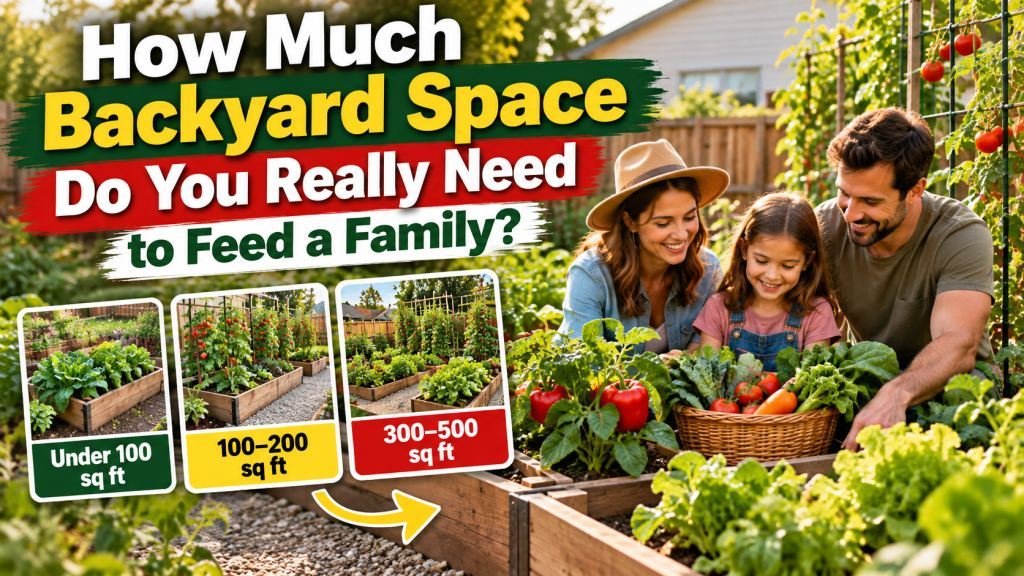
- 100–200 sq ft — enough for a solid rotation of greens, herbs, beans, peppers, and other compact crops.
- 300–500 sq ft — gives you room to add potatoes, root vegetables, squash, tomatoes, and other higher-volume crops.
- Under 100 sq ft — still workable using containers, trellises, vertical systems, and succession planting.
A 100-square-foot garden is only about the size of a 10 × 10-foot area. That may sound small, but a well-organized garden can contain several different growing zones.
For example, one section could produce salad greens, another could hold beans and peppers, while a trellis along the fence could support climbing crops. Vertical growing effectively adds another dimension to your available space. (Agri Farming)
The Key Is Growing Up, Not Just Out
One of the biggest mistakes beginners make is thinking entirely in terms of ground space.
If you have limited room, use fences, walls, trellises, arches, and other supports. Climbing beans, cucumbers, peas, and some tomato varieties can use vertical space instead of spreading across the ground.


You can also combine crops with different growth habits. A taller crop can occupy the upper portion of the garden while shorter greens grow underneath or around it. The goal is to make more than one part of your available space productive.
Raised Beds Can Make Small Spaces Easier
Instead of scattering vegetables throughout the yard, you can divide your growing area into clearly defined beds.
For example, a compact backyard might contain two or three raised beds, a narrow herb section, and a trellis along one fence. This creates dedicated areas for different types of crops while leaving enough room to walk, water, harvest, and maintain the plants.


Raised beds are commonly designed around 2–4 feet wide, making it easier to reach plants without stepping into the growing area. (University of Maryland Extension)
The important thing isn’t simply building more beds. It’s deciding what each bed is supposed to accomplish.
One might be your salad and greens bed, another your tomato and pepper bed, and another your root-crop or storage-crop bed.
Make the Same Space Produce More Than Once
Another powerful technique is succession planting.
Instead of planting an entire bed once and leaving it empty after harvest, you replace finished crops with another crop. For example, quick-growing greens or radishes can be harvested and followed by beans or another suitable seasonal crop.


This means your 200 square feet isn’t necessarily producing only one harvest. The same physical space can potentially produce several crops over the course of a growing season, depending on your local climate and growing conditions. (Agri Farming)
What About Feeding an Entire Family?
This is where expectations matter.
A small backyard garden can provide fresh vegetables, herbs, and some staple crops, but the exact amount of food needed to feed a family depends on household size, diet, growing season, crop yields, preservation methods, and how much of the family’s diet comes from the garden.
Think of your first garden as a way to reduce dependence on the grocery store for certain foods, rather than expecting a small plot to immediately replace every grocery purchase.
Start with foods your family already eats regularly. If everyone loves tomatoes, peppers, beans, potatoes, lettuce, or herbs, give those crops priority rather than filling valuable space with vegetables nobody wants.
You Probably Have Enough Space to Start
The biggest barrier for many beginners isn’t actually square footage. It’s inefficient planning.
A small garden can become surprisingly productive when you combine raised beds, vertical growing, compact varieties, intensive planting, and succession planting.
That’s the actual value of a system like the Backyard Miracle Farm System: instead of starting with a generic farm plan and trying to shrink it down, you can begin with a layout designed around making limited space productive.
You don’t need to wait until you own a large property.
Measure the space you already have, start small, and design the garden around the food your family actually eats.