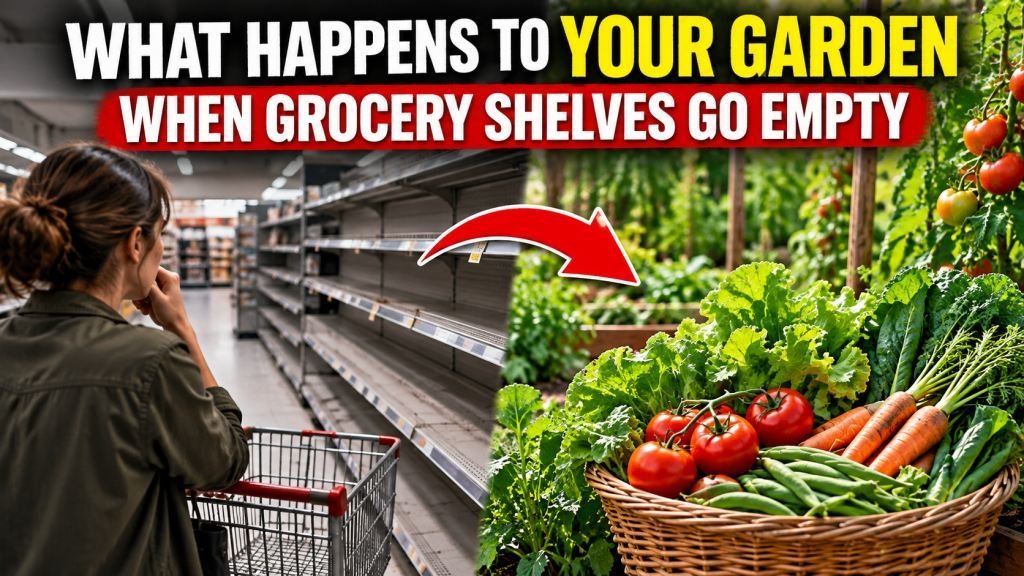
Most people don’t think about their food supply until they’re standing in front of an empty shelf. It’s happened before — weather events, supply chain disruptions, panic-buying cycles — and it tends to happen fast, with no warning window to “start prepping now.”
What actually helps in that moment:
A garden that’s already established doesn’t care what’s happening at the store. A dozen tomato plants, a bed of greens, a few rows of beans — none of it replaces grocery shopping entirely, but it changes your position from “dependent” to “supplementing.” That difference matters more than people expect until they’ve lived through a shortage.


The Catch: A Garden Takes Time
A garden started the week shelves go empty is months too late for many crops. Seeds need time to germinate, plants need to mature, and harvests arrive according to the growing season — not according to when you need them.
That’s why food-security gardening is fundamentally about preparation before a disruption happens.
Even a small garden can provide useful amounts of vegetables when planned properly. In limited spaces, containers and raised beds can make it possible to grow crops such as tomatoes, leafy greens, radishes, herbs and peppers. (India Gardening)
The goal isn’t necessarily to become completely self-sufficient overnight. It’s to gradually reduce how much of your everyday food supply depends on a store being fully stocked.
Grow Food That You Actually Eat
One common mistake is planting whatever happens to look impressive in a seed catalog.
Instead, think about your normal grocery basket.
If your household regularly uses tomatoes, beans, spinach, onions, peppers or herbs, those crops may provide more practical value than unusual vegetables that rarely make it onto your plate.
A productive garden should answer a simple question:
“What food would I miss most if I couldn’t buy it?”
Start there.
Think Beyond a Single Harvest
Food security isn’t just about growing vegetables. It’s also about keeping something available over time.
Instead of planting every seed on one weekend, gardeners can use succession planting — planting another small batch after the previous crop is established or harvested. This can spread production across a longer period rather than creating one enormous harvest followed by nothing.
You can also combine quick-growing crops with longer-season plants. Leafy greens and radishes can provide relatively early harvests while tomatoes, peppers and other crops continue developing.


Don’t Ignore Water
A productive garden is only useful if it can stay alive.
Water availability should therefore be part of your planning from the beginning. Mulching around plants can help reduce moisture loss, while efficient irrigation can make watering more manageable. For container gardening, choosing pots with adequate drainage is also important. (India Gardening)
This is particularly important during hot or dry periods when plants can become stressed quickly.
Start Small — But Start Before You Need It
You don’t need to transform your entire backyard into a farm.
Start with a few containers, a small raised bed, or one manageable section of your yard. Learn how your soil behaves. Figure out how much sunlight you actually receive. Track which crops perform well and which ones don’t.
Then expand.
Over time, you’ll build something much more valuable than a collection of plants: experience.
Because when grocery shelves are full, gardening can feel like a hobby. When supplies become difficult to obtain, the knowledge you’ve already developed can become much more useful.
The Real Prepper Advantage
The advantage isn’t having a huge garden sitting perfectly ready for a crisis.
It’s having a system that is already working.
You know where your seeds are. You know which crops grow well. You understand your watering routine. You’ve already made mistakes and learned from them. And, most importantly, you aren’t trying to learn everything during the same week that everyone else is trying to find food.
If you’re not sure where to start, a laid-out system like the Backyard Miracle Farm System can help organize what to plant and how to approach your garden, rather than leaving you to improvise when the growing season is already underway.
Food security starts long before the shelves become empty. It starts with what you plant today.