Have you ever wondered what happens when you switch on a light, start an air conditioner, or plug in your phone charger? Electricity seems almost invisible, but there is a complete system working behind the walls of your home to safely deliver electrical power where you need it.
From the electricity grid to your meter, distribution panel, wiring, switches, and appliances, every part has a specific role. Understanding this system can also help you identify electricity waste, understand your power bill, and recognize potential electrical problems.
Let’s take a simple look at how home electricity works, from the moment electricity reaches your property to the moment an appliance uses it.
1. Where Does Your Home’s Electricity Come From?
Electricity usually begins at a power-generation facility. Depending on the region and electricity mix, power may come from sources such as solar, wind, hydroelectricity, natural gas, coal, nuclear, or other generation technologies.
The generated electricity is then transported through the electrical grid.


Electricity travels through different stages:
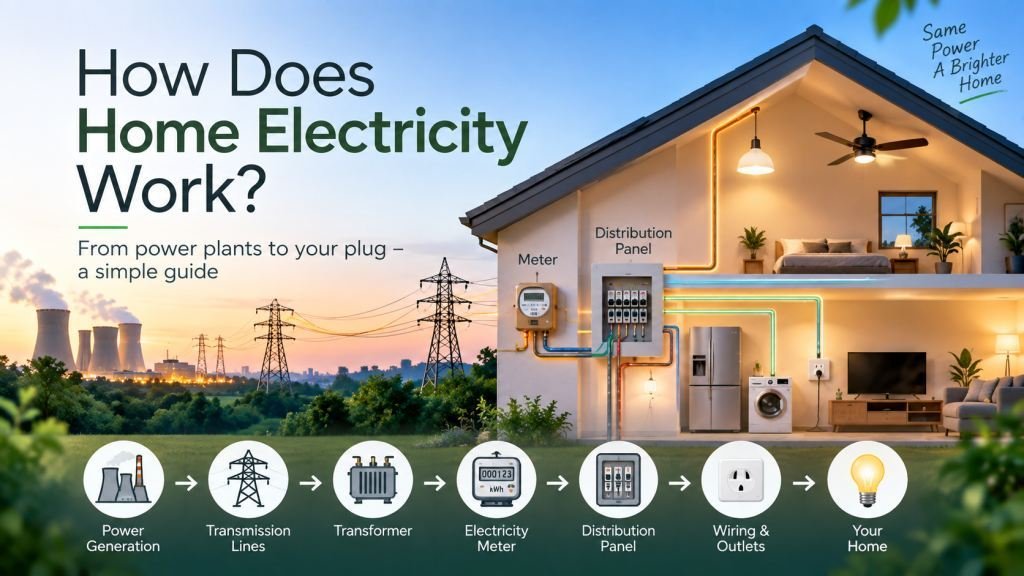
Generation → Transmission → Distribution → Home → Appliance
Large transmission lines carry electricity over long distances at high voltages. Distribution networks then reduce the voltage through transformers before electricity reaches homes and other buildings.
The electricity supplied to your home is therefore part of a much larger interconnected system.
2. Electricity Enters Your Home Through a Service Connection
After traveling through the distribution network, electricity reaches your property through a service connection.
The exact arrangement varies by country and utility, but a typical home electrical system includes:
- Service connection
- Electricity meter
- Main switch or isolator
- Distribution panel
- Circuit breakers
- Electrical wiring
- Switches and outlets
- Appliances
These components work together to distribute electricity safely throughout the house.
3. What Does the Electricity Meter Do?
The electricity meter measures how much electrical energy your home consumes.


Electricity consumption is commonly measured in kilowatt-hours (kWh).
A kilowatt-hour represents the amount of energy used by a 1-kilowatt load operating for one hour.
For example:
1 kW × 1 hour = 1 kWh
If a 1,000-watt appliance operates continuously for one hour, it would use approximately 1 kWh.
Your electricity provider uses the measured consumption, along with the applicable tariff and other charges, to calculate your bill.
4. Electricity Goes to the Distribution Panel
Once electricity passes through the meter and main equipment, it reaches your home’s distribution panel.
The distribution panel is essentially the control center of your home’s electrical system.


Inside the panel are circuit breakers or similar protective devices.
Instead of sending all the electricity through one large circuit, the home’s electrical system is divided into multiple circuits.
For example, separate circuits may supply:
- Lighting
- General outlets
- Kitchen appliances
- Air conditioning
- Water heater
- Washing machine
- Other high-power equipment
Dividing the system into circuits makes it easier to manage electrical loads and provides protection when a problem occurs.
5. What Is a Circuit Breaker?
A circuit breaker is a safety device designed to interrupt electrical current when certain abnormal conditions occur, such as an overload or short circuit.
Imagine a circuit that is designed to safely carry a certain amount of current. If too much current flows, wiring and equipment can overheat.
The circuit breaker can disconnect the circuit to help prevent damage and reduce fire risk.
If a breaker repeatedly trips, however, simply resetting it again and again is not a solution. The underlying cause should be investigated by a qualified electrician.
6. How Does Electricity Reach a Light or Appliance?
Electricity travels through conductors, usually copper or aluminum wiring, to electrical outlets, switches, and appliances.
A basic household circuit has conductors that provide a path for current to flow to and from the electrical source.
When you switch on a light, the switch changes the circuit so current can flow through the lamp.


The appliance then converts electrical energy into another form of energy.
For example:
- Light bulb: electrical energy → light and heat
- Fan: electrical energy → mechanical motion
- Heater: electrical energy → heat
- Speaker: electrical energy → sound
- Refrigerator: electrical energy → cooling through a refrigeration cycle
- Television: electrical energy → light and sound
This is why different appliances can have dramatically different electricity requirements.
7. AC and DC: What’s the Difference?
The electricity supplied through typical household outlets is alternating current (AC).
Many electronic devices, however, operate internally using direct current (DC).
This is why devices such as phones, laptops, routers, and LED electronics often use power adapters or chargers.
The charger converts the incoming electrical power into the voltage and type of power required by the device.
For example, a phone charger takes electricity from the household supply and converts it into a much lower voltage suitable for charging the phone’s battery.
8. Why Do Some Appliances Use More Electricity?
Not every appliance consumes electricity at the same rate.
Electrical power is commonly expressed in watts (W) or kilowatts (kW).
An appliance with a higher power rating can use energy more quickly when operating.
For example, heating devices can require substantial electrical power because converting electricity into heat requires significant energy.
Common high-energy household loads can include:
- Air conditioners
- Electric water heaters
- Electric ovens
- Induction cooktops
- Clothes dryers
- Water pumps
However, actual electricity consumption depends on both power and operating time.
A lower-power appliance operating continuously can sometimes consume more energy over a month than a high-power appliance used only occasionally.
9. Why Does Your Electricity Bill Change?
Your monthly electricity bill is primarily related to how much electrical energy you consume during the billing period, along with the applicable tariff structure and other charges.
Several things can increase consumption:
More AC usage + longer operating hours + additional appliances = higher energy consumption
For example, during hot weather, air conditioners may operate for much longer. This can significantly increase household electricity consumption.
Similarly, using electric water heaters more frequently, adding a new appliance, or spending more time at home can increase the number of kWh consumed.
10. What About Electricity When Appliances Are “Off”?
Some electronic equipment can continue drawing a small amount of electricity while connected to the power supply, even when it isn’t actively being used. This is commonly referred to as standby power.
Examples can include:
- Televisions
- Game consoles
- Computers
- Speakers
- Chargers
- Printers
- Networking equipment
The amount varies considerably by device.
Switching off equipment completely when practical can reduce unnecessary consumption.
11. Why Is Grounding Important?
A properly designed electrical system also includes protective measures such as grounding/earthing.
Grounding provides a path that can help safely carry fault current away from exposed conductive parts under certain fault conditions, allowing protective devices to operate.
Modern electrical systems also use additional protective technologies, such as residual-current protection, where required or appropriate.
Electrical safety systems vary depending on local standards and installation design.
Never remove, bypass, or modify electrical safety devices.
12. How Does Electricity Become Useful Energy?
The fascinating part of home electricity is that the same basic electrical supply can perform many different jobs.
A refrigerator uses electricity to operate a compressor and refrigeration system.
A fan uses a motor to create movement.
A water heater converts electrical energy into thermal energy.
A television uses electronic circuits to produce images and sound.
A washing machine combines motors, pumps, controls, and sometimes heating elements.
In other words, electricity is an energy carrier. Appliances convert that electrical energy into the forms we actually use.
Final Thoughts
Home electricity is part of a complex system that begins with electricity generation and continues through transmission lines, transformers, distribution networks, meters, panels, circuits, and finally your appliances.
The basic journey can be summarized as:
Power Plant → Grid → Transformer → Meter → Distribution Panel → Circuit → Appliance
Understanding this flow makes it easier to understand electricity bills, appliance power ratings, energy efficiency, and basic electrical safety.
Most importantly, electrical systems can be dangerous. Work involving household wiring, electrical panels, service connections, or other high-voltage components should be handled by a qualified electrician and according to applicable local electrical codes and safety requirements.
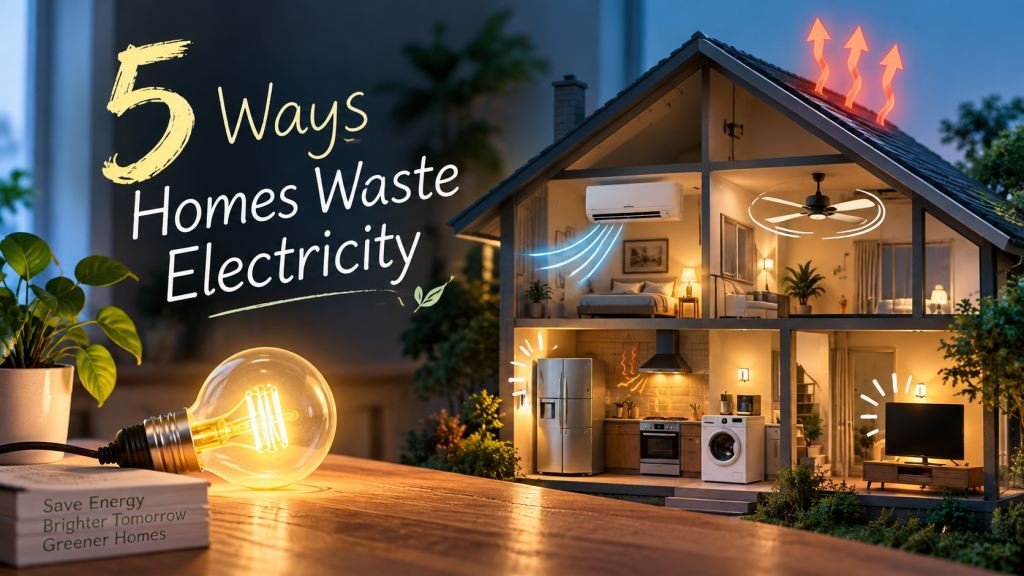
Once you understand how electricity reaches your home, the next useful question is: where is all that electricity actually going? Tracking the biggest energy-consuming appliances is often the first step toward reducing unnecessary electricity use and lowering your monthly bill.