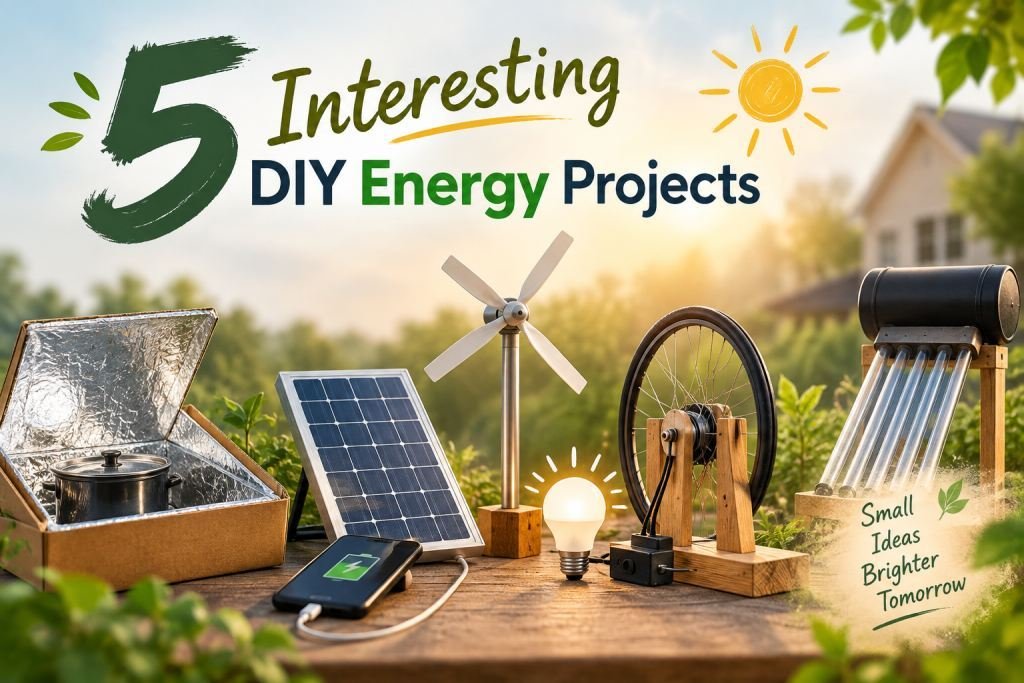
Energy doesn’t always have to come from a wall socket or a fuel-powered machine. With a few inexpensive materials, it is possible to build small projects that demonstrate how sunlight, wind, heat, and human motion can be converted into useful energy.
These projects are particularly interesting for DIY enthusiasts, students, makers, and homeowners who want to understand renewable energy through hands-on experiments. Some can even become practical additions to a backyard or workshop.
Safety note: Keep DIY electrical projects at low voltage whenever possible. Avoid connecting homemade systems directly to household wiring or mains electricity. For larger solar, wind, battery, or water-heating systems, use appropriate protection and professional installation.
1. Build a Simple Solar Oven


One of the easiest ways to understand solar energy is by building a solar oven. Instead of converting sunlight into electricity, this project converts sunlight directly into heat.
A basic solar oven can be made from a cardboard box, aluminum foil, transparent plastic wrap or a suitable transparent cover, black paper, and insulation material. The inside of the box absorbs sunlight while reflective surfaces redirect additional sunlight toward the cooking area.
The basic idea is surprisingly simple. Reflective surfaces concentrate sunlight, dark surfaces absorb heat, and a transparent cover helps retain the heat inside. Pizza-box solar ovens are commonly used as educational projects because they demonstrate these principles using inexpensive materials. (DIY Science Projects)
Place the oven in direct sunlight and adjust the reflective flap toward the Sun. On a sunny day, the temperature inside can rise significantly.
You can experiment with different designs by changing the amount of insulation, the angle of the reflector, or the color of the cooking surface. A thermometer can also turn the project into a simple science experiment by allowing you to record temperature changes throughout the day.
Best for: Science projects, outdoor experiments, children with adult supervision, and learning about solar thermal energy.
2. Make a Small Solar USB Charger


Solar panels convert sunlight into electrical energy, making them perfect for small portable energy projects.
A simple solar USB charger can use a small photovoltaic panel, a suitable charge-control or voltage-regulation circuit, wiring, and a USB output. Small experimental designs have also been made using recycled solar panels from garden lights and similar devices.
The important part is voltage regulation. A solar panel’s output can vary depending on sunlight, temperature, and the load connected to it. A suitable regulator helps provide a stable output rather than connecting a phone directly to an unpredictable panel.
For beginners, it is better to start with a commercially available low-voltage solar charging module designed for the intended battery or USB output.
You can mount the components inside a small project box and add a USB port to create a portable charger. A rechargeable battery can also be incorporated when using a charging circuit designed specifically for that battery chemistry.
The project teaches several important concepts at once: photovoltaic conversion, voltage regulation, energy storage, and electrical efficiency.
Best for: Beginners interested in electronics, camping accessories, emergency charging, and portable solar experiments.
3. Turn a Bicycle Into a Generator


What if your own legs could produce electricity?
A bicycle generator demonstrates the conversion of mechanical energy into electrical energy. The bicycle is mounted on a stationary stand so that the rear wheel can spin freely. The rotating wheel drives a generator or suitable motor, producing electrical power.
Real DIY bicycle-generator projects have demonstrated that human pedaling can produce useful amounts of electricity, although the output depends heavily on the generator, gearing, rider, and duration of pedaling. One documented maker project developed a bicycle setup capable of producing around 100 watts under suitable conditions.
A simpler version can be designed to illuminate LEDs or charge a small battery through appropriate electronics.
The project is particularly useful because it makes an invisible concept—energy conversion—easy to see. When you pedal faster, the generator can produce more energy, while electrical resistance can make the bicycle harder to pedal.
It also demonstrates an important reality of renewable energy: energy still has to come from somewhere. In this case, the energy comes from the rider’s physical effort.
Best for: Fitness experiments, school demonstrations, emergency lighting, and learning about mechanical-to-electrical energy conversion.
4. Experiment With a Mini Wind Turbine


Wind energy provides another fascinating way to generate electricity. A small experimental turbine can use blades connected to a generator, allowing moving air to produce electrical power.
One accessible DIY approach uses lightweight PVC blades and bicycle components. Make: has documented a small vertical-axis wind project using a bicycle wheel and hub dynamo, designed primarily as an educational experiment. Its example produced roughly 1 watt—enough for small loads but nowhere near enough to power an entire home. (Make: DIY Projects and Ideas for Makers)
That limitation is actually an important lesson.
Wind turbines depend heavily on wind speed and location. A turbine placed somewhere with weak or turbulent airflow may generate very little energy. Strong winds can also create significant mechanical and safety risks.
For a beginner project, concentrate on measuring voltage or lighting a small LED rather than attempting to connect the turbine to household appliances.
Try changing the blade shape, number of blades, or rotor size and record how the output changes.
Best for: Outdoor experiments, engineering students, makers, and renewable-energy demonstrations.
5. Build a Solar Water Heater Experiment


Solar energy can also be used directly to heat water without first converting it into electricity.
A simple experimental solar water heater can use dark-colored tubing or containers exposed to sunlight. Dark surfaces absorb solar radiation and transfer the heat to water flowing through or stored inside the system.
More advanced DIY systems can use insulated tanks, circulation pumps, collectors, and temperature sensors. The basic principle remains the same: capture solar radiation and transfer its heat to water.
This type of project is particularly interesting because it demonstrates why energy doesn’t always need to be converted into electricity. If your goal is simply to heat water, using solar thermal energy directly can avoid the conversion losses associated with generating electricity first.
However, heated water can cause serious burns, and pressurized hot-water systems can be dangerous. Keep beginner experiments small, unpressurized, and carefully monitored.
Best for: Understanding solar thermal energy, backyard experiments, sustainability demonstrations, and science projects.
Start Small and Experiment
The most valuable part of DIY energy projects isn’t necessarily how much electricity they produce. It’s understanding where energy comes from, how it moves, and how efficiently it can be converted into another form.
A cardboard solar oven demonstrates heat from sunlight. A solar charger demonstrates photovoltaic electricity. A bicycle generator converts human motion into electricity, while a wind turbine uses moving air. A solar water heater shows how sunlight can provide useful heat without electricity at all.
You can make each project more interesting by adding a multimeter, thermometer, small display, or data logger and recording the results.
Start with low-voltage, low-power experiments, learn how each component works, and gradually improve your designs. Sometimes the smallest DIY project can provide the biggest lesson about how energy really works.