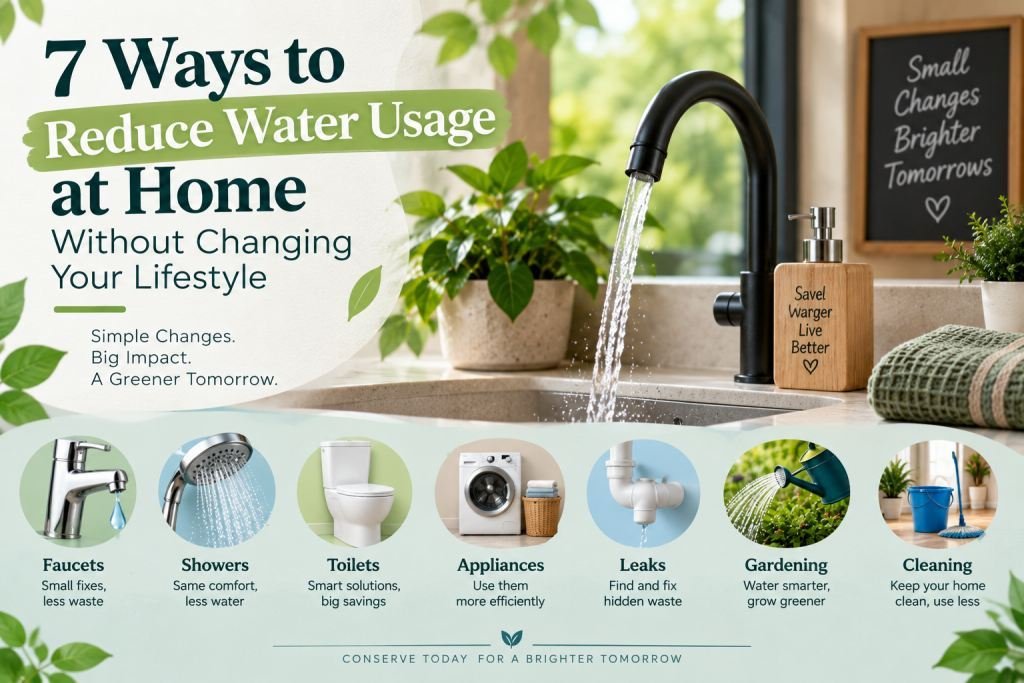
Saving water does not have to mean taking cold showers, giving up your garden, or drastically changing your daily routine. In many homes, a significant amount of water is wasted through small inefficiencies: a tap that runs longer than necessary, a leaking toilet, an inefficient appliance, or garden watering at the wrong time.
The good news is that many water-saving improvements can happen in the background. Once you make a few simple changes, they can continue saving water every day without requiring much extra effort.


5
1. Make Your Faucets More Efficient
Kitchen and bathroom faucets are used dozens of times every day. Even a small amount of unnecessary flow can add up over weeks and months.
One simple improvement is installing a water-efficient faucet aerator. An aerator mixes air into the water stream, helping maintain useful pressure while reducing the amount of water flowing through the tap.
You can also develop small habits that don’t really change your lifestyle:
- Turn the tap off while brushing your teeth.
- Don’t leave water running while washing dishes.
- Fill a container when you need water for cooking or cleaning.
- Repair dripping faucets promptly.
A faucet that drips continuously may seem insignificant, but a leak that continues around the clock can waste a considerable amount of water over time.
Easy upgrade:
Instead of remembering to “use less water,” make the tap itself more efficient.
2. Reduce Shower Water Without Taking Shorter Showers
Nobody wants water conservation to make their morning routine unpleasant. Fortunately, you can often reduce shower consumption without dramatically changing your routine.
A low-flow showerhead can reduce the amount of water delivered while still providing a comfortable shower. Actual savings depend on the showerhead’s flow rate and how long it is used.
Another simple strategy is to turn the water off briefly while applying soap or shampoo.


6
You can also collect the water that runs while waiting for the shower to reach a comfortable temperature, provided it is clean and suitable for another purpose. For example, it may be useful for watering plants or cleaning, depending on how it was collected.
The goal isn’t necessarily to eliminate showers or make them uncomfortable. It’s to make the water delivery more efficient.
3. Make Your Toilet Use Less Water
Toilets can represent a surprisingly large portion of indoor household water consumption.
If you’re replacing an old toilet, consider a dual-flush or water-efficient model. These systems provide different flush volumes for different needs.
But you don’t necessarily need to replace your toilet immediately.
First, check for leaks.
A toilet that quietly continues running after flushing can waste water continuously. One simple way to check is to add a small amount of food coloring to the toilet tank and wait without flushing. If colored water appears in the bowl, the toilet may have a leak that needs attention.


6
Fixing a hidden toilet leak can be one of the easiest ways to reduce water waste without changing your daily routine.
4. Use Appliances More Efficiently
Washing machines and dishwashers can use substantial amounts of water, but you don’t have to stop using them to conserve water.
Instead, use them efficiently.
For washing machines:
- Wash full loads when practical.
- Select an appropriate water-saving cycle.
- Avoid washing clothes unnecessarily.
- Check the manufacturer’s recommended settings.
For dishwashers:
- Run full loads where practical.
- Scrape food from plates instead of excessively pre-rinsing.
- Use the appropriate cycle for the load.
Modern appliances can be designed with water efficiency in mind, but actual consumption varies considerably between models and settings.


5
The key idea is simple: let the appliance do a full job instead of repeatedly running smaller cycles.
5. Find and Fix Hidden Leaks
Leaks are one of the easiest sources of water waste to overlook because they often happen when nobody is using water.
Common problem areas include:
- Faucets
- Toilet tanks
- Shower connections
- Washing machine hoses
- Outdoor taps
- Underground plumbing
- Water heater connections
Check visible plumbing regularly for damp areas, dripping sounds, puddles, or unexplained moisture.
If your home has a water meter, you can perform a simple household check. Make sure all taps and water-using appliances are turned off, then observe the meter. If it continues recording water use, there may be a leak somewhere in the system.
For suspected underground or difficult-to-access leaks, a qualified plumber can help identify the problem.
6. Water Your Garden Smarter
A beautiful garden doesn’t have to disappear just because you’re trying to conserve water.
In fact, changing when and how you water can often be more effective than simply watering less.
Watering early in the morning or later in the evening can reduce water lost through evaporation compared with watering during the hottest part of the day.


7
Other useful strategies include:
Use drip irrigation
Drip systems deliver water closer to plant roots rather than spraying large areas.
Add mulch
A layer of suitable organic mulch can help the soil retain moisture and reduce evaporation.
Choose suitable plants
Plants adapted to your local climate may require less supplemental watering.
Check before watering
Don’t automatically water simply because it is part of your schedule. Check whether the soil actually needs additional moisture.
If you collect rainwater, it may also provide a useful source for appropriate outdoor applications, subject to local conditions and regulations.
7. Stop Wasting Water During Everyday Cleaning
Cleaning activities can quietly add up to a significant amount of water use.
For example, leaving a hose running while washing outdoor areas can use much more water than necessary. Similarly, continuously running a tap while cleaning kitchen surfaces or washing dishes can increase consumption.
Instead, use controlled amounts of water.
A bucket can be useful for certain outdoor cleaning tasks, while spray bottles or damp cloths can handle many indoor cleaning jobs without requiring a constantly running tap.
For mopping, use only the amount of water needed for the floor rather than repeatedly replacing large quantities of water.


6
Small Changes Can Add Up
Water conservation doesn’t have to feel like a lifestyle sacrifice.
The most effective approach is often to make your home more efficient rather than simply asking everyone to use less water.
A faucet aerator can reduce flow. A better showerhead can improve efficiency. A leaking toilet can be repaired. Full appliance loads can reduce unnecessary cycles. Smarter irrigation can deliver water directly where plants need it.
Here’s a simple checklist to get started:
| Area | Simple Improvement |
|---|---|
| Faucets | Install aerators and fix drips |
| Shower | Use an efficient showerhead |
| Toilet | Check for leaks and consider dual-flush models |
| Laundry | Run appropriate full loads |
| Dishwasher | Avoid excessive pre-rinsing |
| Plumbing | Check regularly for hidden leaks |
| Garden | Water at suitable times and use drip irrigation |
| Cleaning | Avoid continuously running taps or hoses |
The Best Water-Saving Strategy? Make It Automatic
The easiest habits to maintain are the ones you don’t have to think about.
Instead of relying entirely on daily reminders, improve the systems around you. Install efficient fixtures, repair leaks, adjust appliance settings, improve irrigation, and make small changes to how water moves through your home.
Once these improvements become part of your home, you can continue enjoying the same showers, meals, laundry routine, garden, and cleaning habits—while using water more efficiently.
Saving water isn’t necessarily about doing less. It’s about wasting less.