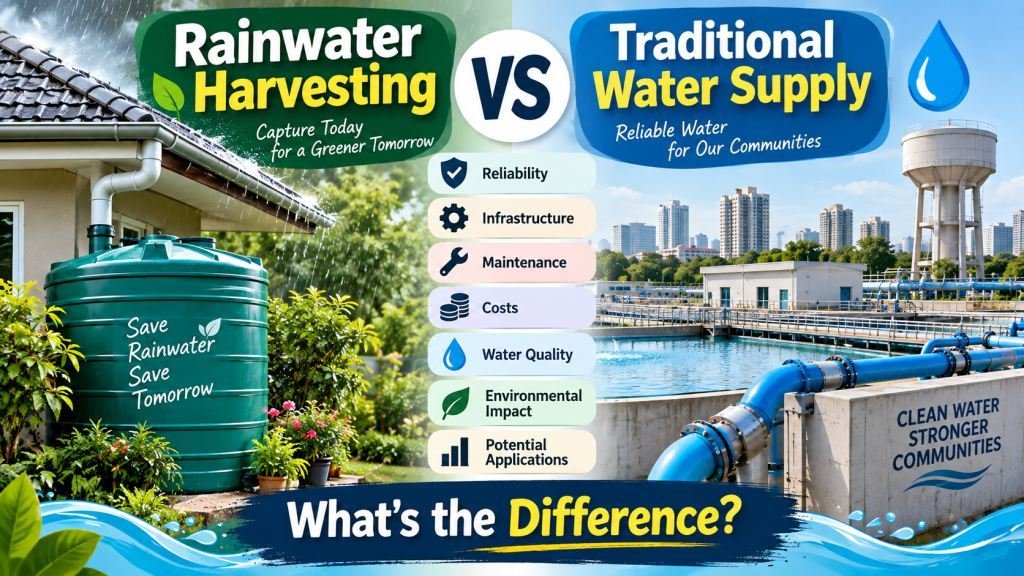
Water is one of the most important resources in any home, business, or community. Yet the way we obtain water can vary greatly. Two common approaches are rainwater harvesting and traditional water supply systems.
Traditional water supply usually delivers treated water through a centralized network of pipelines, reservoirs, treatment plants, and pumping stations. Rainwater harvesting, on the other hand, captures rainfall directly from rooftops or other surfaces and stores or redirects it for later use.
Both systems have advantages and limitations. Understanding their differences can help households, businesses, schools, and communities make better decisions about water management.


Understanding Rainwater Harvesting
Rainwater harvesting is the process of collecting rain as it falls and storing it for future use. A typical household system may include a rooftop collection area, gutters, downpipes, filters, a storage tank, and sometimes a pump.
Collected rainwater can be used for activities such as gardening, toilet flushing, cleaning, and—in systems designed and treated appropriately—drinking and cooking.
One of its biggest advantages is that it allows water to be collected close to where it is needed. Instead of relying entirely on a distant water source, a building can make use of rainfall available on its own property.
Understanding Traditional Water Supply
Traditional water supply systems are generally much larger in scale. Water may come from rivers, lakes, reservoirs, groundwater sources, or other sources. It is then collected, treated, stored, and distributed through a network of pipes.
Municipal water systems are designed to serve large populations. Water treatment and quality control are usually handled centrally before water reaches homes and businesses.
This approach provides convenience because users generally do not need to maintain their own source, storage infrastructure, or treatment facility.
Reliability: Which System Provides More Consistent Water?
Reliability is one of the biggest differences between the two approaches.
Traditional water supply can provide a relatively continuous source of water because large reservoirs, treatment facilities, and distribution networks are designed to meet demand throughout the year. However, supply can still be affected by droughts, pipeline failures, power outages, infrastructure problems, or periods of unusually high demand.
Rainwater harvesting depends directly on rainfall. During the rainy season, a properly sized system can collect significant quantities of water. During prolonged dry periods, however, storage tanks can eventually run empty.
The reliability of a rainwater harvesting system therefore depends heavily on local rainfall patterns, roof area, storage capacity, and household consumption.
For many properties, rainwater harvesting works best as a supplementary source rather than the only source of water.
Infrastructure Requirements
Traditional water supply requires extensive infrastructure. This can include:
- Dams and reservoirs
- Water treatment plants
- Pumping stations
- Large pipelines
- Storage facilities
- Distribution networks
- Monitoring and treatment equipment
Most of this infrastructure is operated by municipalities or water utilities rather than individual households.
Rainwater harvesting infrastructure is much smaller. A basic system may require:
- Roof or collection surface
- Gutters and downpipes
- First-flush device
- Filters
- Storage tank
- Pump or gravity-fed outlet
- Overflow or recharge arrangement
Because of its smaller scale, rainwater harvesting can be installed at individual homes, apartment buildings, schools, offices, farms, and other properties.
Maintenance Requirements
Both systems require maintenance, but the responsibility is different.
With traditional water supply, the utility generally handles major infrastructure maintenance. Consumers usually only need to maintain their internal plumbing, faucets, tanks, and fixtures.
Rainwater harvesting puts more responsibility on the property owner. Roofs and gutters need to be kept clean, filters need periodic attention, and storage tanks should be inspected and cleaned when necessary.
Poorly maintained collection systems can allow leaves, dirt, insects, and other contaminants to enter storage tanks. If rainwater is intended for drinking, appropriate treatment and testing are particularly important.
Cost Differences
The cost comparison depends heavily on location, system size, water tariffs, rainfall, and installation requirements.
Traditional water supply usually involves a relatively simple connection for the consumer, but users pay recurring water charges. The major infrastructure costs are distributed across the wider system.
Rainwater harvesting generally requires an upfront investment for tanks, pipes, filters, pumps, and installation. Once installed, however, the system can reduce dependence on purchased or municipal water for suitable applications.
For example, harvested rainwater may be used for gardening or toilet flushing, reducing the amount of treated drinking-quality water required for those activities.


Water Quality Considerations
Traditional municipal water is generally treated before distribution and is intended to meet applicable drinking-water standards. However, water quality can vary depending on the source, treatment process, distribution infrastructure, and local conditions.
Rainwater starts relatively clean but can collect contaminants from the atmosphere, roof surfaces, gutters, storage tanks, and plumbing.
This means untreated rainwater should not automatically be considered drinking water. If it is intended for potable use, the system needs appropriate filtration, disinfection, storage practices, and regular water-quality monitoring.
For non-potable applications such as gardening, cleaning, or toilet flushing, treatment requirements may be different depending on local regulations and the specific use.
Environmental Impact
Rainwater harvesting can provide environmental benefits by reducing stormwater runoff and making productive use of rainfall.
In areas where heavy rainfall causes flooding or drainage problems, capturing some rooftop runoff can reduce the immediate volume entering drainage systems. Some systems can also direct excess water toward groundwater recharge structures where appropriate.
Traditional water supply systems are essential for modern cities but require significant infrastructure and energy for water collection, treatment, pumping, and distribution.
Neither system completely replaces the other. Instead, combining efficient water use with rainwater harvesting can reduce pressure on centralized supplies.
Potential Applications
Rainwater harvesting can be particularly useful for:
- Residential homes
- Apartment buildings
- Schools and colleges
- Offices
- Farms and gardens
- Commercial buildings
- Industrial facilities
- Groundwater recharge projects
Traditional water supply remains particularly important for:
- Large urban populations
- Hospitals and healthcare facilities
- High-density residential areas
- Industrial operations
- Commercial buildings
- Communities requiring continuous water access
- Areas with limited or unreliable rainfall
The two systems can also work together. A building might use municipal water for drinking and cooking while using harvested rainwater for gardening, cleaning, or toilet flushing.
Rainwater Harvesting vs. Traditional Water Supply: At a Glance
| Factor | Rainwater Harvesting | Traditional Water Supply |
|---|---|---|
| Source | Local rainfall | Surface water or groundwater |
| Reliability | Depends on rainfall and storage | Generally more continuous |
| Infrastructure | Small-scale, property-based | Large centralized network |
| Maintenance | Owner responsibility | Mainly utility responsibility |
| Initial cost | Installation required | Usually connection-based |
| Recurring cost | Potentially lower for suitable uses | Regular water charges |
| Water quality | Requires appropriate treatment for intended use | Centrally treated |
| Environmental role | Can reduce runoff and demand | Supports large-scale water access |
| Best suited for | Supplementary/local water needs | Continuous community supply |
Can the Two Systems Work Together?
Yes. In fact, combining them can provide a practical approach to water management.
A household could use traditional water for drinking and cooking while collecting rainwater for gardening and toilet flushing. During rainy periods, harvested water could reduce demand on the main supply. During dry periods, the traditional system could provide backup.
This approach creates a form of water-source diversification. Instead of depending completely on one source, users can make use of available rainfall while retaining access to a reliable conventional supply.
Final Thoughts
Rainwater harvesting and traditional water supply serve different purposes. Traditional systems are designed to deliver treated water to large populations through extensive infrastructure, while rainwater harvesting allows individual properties and communities to capture a local and renewable source.
Rainwater harvesting is particularly useful for reducing dependence on centralized water supplies and making better use of rainfall. Its effectiveness depends on climate, storage capacity, available collection area, maintenance, and intended water use.
For many homes and buildings, the most practical approach isn’t choosing one system exclusively. Using rainwater harvesting alongside traditional water supply can provide additional water resilience while encouraging more responsible use of this valuable resource.
Every drop captured, conserved, and used wisely can contribute to a more sustainable water future.