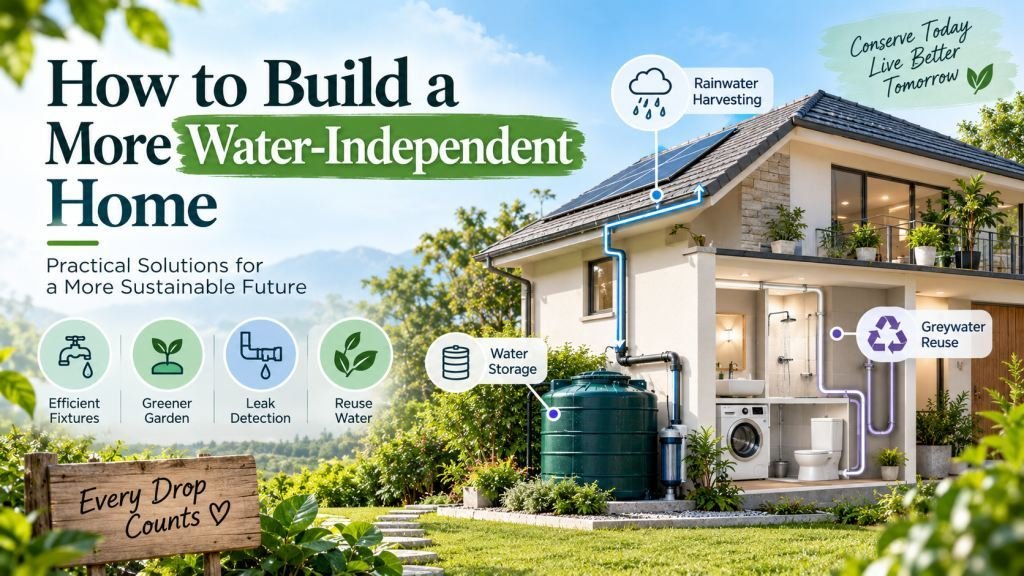
A water-independent home does not necessarily mean living completely off-grid or disconnecting from the municipal water supply. Instead, it means creating a home that can collect, store, reuse, and manage water more efficiently, reducing dependence on a single water source.
With the right combination of rainwater harvesting, storage, efficient fixtures, greywater reuse, and leak detection, homeowners can make their water systems more resilient while reducing unnecessary consumption.
The best approach is to think of the home as a water cycle rather than a place where water simply enters through a pipe and leaves through a drain.


6
What Does a Water-Independent Home Mean?
A water-independent home is designed to make better use of the water already available.
Instead of relying entirely on treated municipal water for every activity, different water sources can be matched to different needs.
For example:
- Drinking and cooking: treated potable water
- Bathing: treated household supply
- Toilet flushing: potentially rainwater or appropriately treated recycled water
- Gardening: rainwater or suitable reused water
- Outdoor cleaning: rainwater or other appropriate non-potable sources
The exact setup depends on local regulations, climate, available space, and household requirements.
1. Start With Rainwater Harvesting
Rainwater is one of the most accessible alternative water sources for many homes.
A rooftop can act as a large collection surface. Gutters direct rainfall into downpipes, where the water can pass through screens and filters before reaching a storage tank.


6
A basic system typically includes:
Roof → Gutter → First-Flush Diverter → Filter → Storage Tank → Intended Use
The first-flush component is useful because the beginning of a rainfall event can wash dust and debris from the roof. Diverting this initial runoff can help improve the quality of water entering the storage tank.
How much water you can collect depends on your roof area, rainfall, and collection efficiency.
A simple estimation method is:
Collected water ≈ Roof area × Rainfall × Runoff efficiency
For example, 100 square metres of roof receiving 20 mm of rainfall could theoretically receive about 2,000 litres before collection losses.
2. Build Adequate Water Storage
Collecting rainwater is only useful if you have somewhere to store it.
Storage capacity should be based on factors such as:
- Roof size
- Local rainfall patterns
- Household water demand
- Available installation space
- Expected dry periods
- Intended uses for harvested water
Storage tanks can be installed above ground or underground.


6
Keep storage tanks covered to reduce contamination, mosquito breeding, algae growth, and debris entering the water.
An overflow system is also important. During heavy rainfall, excess water can be directed toward an appropriate drainage area or groundwater recharge system where permitted and properly designed.
3. Reuse Suitable Household Water
Another way to reduce dependence on fresh water is to reuse certain wastewater streams.
Greywater generally refers to wastewater from sources such as showers, bathroom sinks, and laundry, excluding toilet waste. Depending on local regulations and the treatment system, greywater may be suitable for applications such as landscape irrigation or toilet flushing.
However, greywater should not simply be collected and stored indefinitely.
A proper greywater system should be designed to prevent contamination, unpleasant odours, standing water, and health risks. Household cleaning products can also affect whether greywater is appropriate for particular uses.


6
For example, treated shower or laundry water could potentially be redirected to suitable landscaping systems.
Important: Greywater reuse requirements vary by location. Check local plumbing, building, and environmental regulations before installing a system.
4. Install Water-Efficient Fixtures
Reducing demand is just as important as finding additional water sources.
If a home uses less water in the first place, rainwater tanks and other alternative sources can last longer.
Consider efficient fixtures such as:
- Faucet aerators
- Water-efficient showerheads
- Dual-flush toilets
- Efficient washing machines
- Water-saving dishwashers
A faucet aerator is particularly simple to install. It can reduce flow while maintaining a useful stream by mixing air with water.
Similarly, efficient showerheads can reduce water flow without necessarily making the shower uncomfortable.
The goal is not to change how you live but to make the equipment you already use more efficient.
5. Make Leak Detection a Regular Habit
A water-independent home can still waste large quantities of water if leaks go unnoticed.
Small leaks can occur at faucets, toilets, pipes, washing-machine connections, outdoor taps, and other plumbing fixtures.


8
One simple method is to check your water meter when nobody is using water.
Turn off taps and water-using appliances and observe the meter. If water consumption continues when everything should be inactive, investigate further.
Some modern water meters and smart monitoring systems can provide more detailed information about unusual water use.
Regularly checking visible plumbing can also help identify problems before they become expensive repairs.
6. Connect the Systems Together
The biggest benefit comes from combining different strategies rather than relying on one solution.
Imagine a home with:
Rainwater harvesting
↓
Filtration
↓
Storage tank
↓
Garden / suitable non-potable uses
At the same time:
Efficient fixtures
↓
Lower household demand
And:
Suitable greywater
↓
Treatment system
↓
Approved reuse
Together, these systems can reduce the amount of fresh water required by the household.
7. Use Water According to Its Quality
One of the most important principles of water independence is understanding that not every task requires drinking-quality water.
Drinking and cooking require appropriately treated potable water. Gardening, toilet flushing, and some outdoor applications may have different water-quality requirements.
Using high-quality drinking water for every possible household task can increase demand unnecessarily.
However, alternative water sources should only be used when they are appropriately treated and legally permitted for the intended purpose.
A Practical Water-Independent Home Plan
You don’t have to install everything at once.
A gradual approach can make the transition easier:
| Stage | Improvement |
|---|---|
| 1 | Fix visible leaks |
| 2 | Install efficient faucets and showerheads |
| 3 | Upgrade inefficient toilets |
| 4 | Add rainwater collection |
| 5 | Install appropriate storage |
| 6 | Improve garden irrigation |
| 7 | Explore regulated greywater reuse |
| 8 | Add water monitoring |
This approach lets you improve efficiency first and then add alternative water sources as your budget and property allow.
The Goal Is Resilience, Not Complete Independence
Building a more water-independent home is not about eliminating the municipal water connection overnight. For most households, a more realistic goal is greater water resilience.
Rainwater harvesting provides an additional source. Storage helps bridge periods between rainfall events. Efficient fixtures reduce demand. Greywater systems can potentially reuse suitable wastewater. Leak detection prevents hidden losses.
When these strategies work together, your home becomes better prepared to manage water efficiently.
The most important first step is simple: understand how much water your home uses and where it goes.
Once you know your household’s biggest water demands, you can choose the improvements that make the most sense for your home, climate, available space, budget, and local regulations.