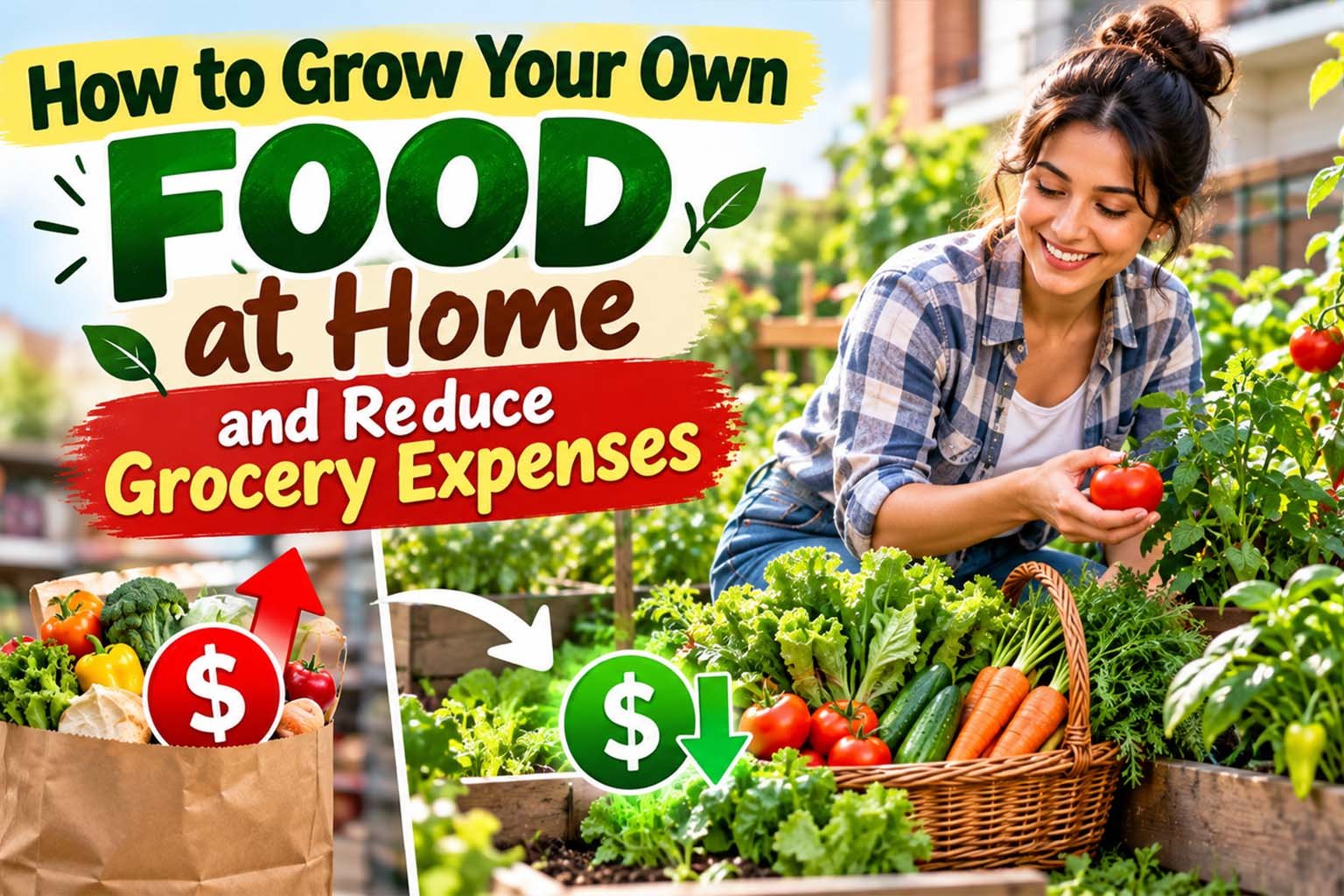
Grocery bills can add up quickly, especially when fresh vegetables, herbs, and fruits are purchased every week. One practical way to reduce some of these expenses is to grow part of your own food at home.
You don’t need a large farm or an enormous backyard to get started. A small garden, balcony, patio, terrace, or even a few containers can produce useful amounts of fresh food. With proper planning, home gardening can become both a rewarding hobby and a practical way to make your grocery budget go further.


Start With the Food You Buy Most Often
Before buying seeds or containers, take a look at your regular grocery list. Which vegetables and herbs do you purchase repeatedly?
Items such as green onions, coriander, tomatoes, peppers, spinach, lettuce, mint, basil, and other leafy greens can be good starting points because they are frequently used in everyday cooking.
Growing food that you already consume makes your garden more practical. Instead of planting something simply because it looks interesting, focus on crops that can actually replace some of your regular grocery purchases.
For example, if your family regularly uses fresh herbs, growing a few pots of herbs may provide more practical value than dedicating the same amount of space to a vegetable you rarely eat.


Choose Crops That Match Your Space
The amount of available space should determine what you grow. A small backyard can support considerably more than a balcony, while a sunny windowsill may be suitable mainly for herbs.
If you have limited space, consider vegetables that grow vertically or remain relatively compact. Tomatoes, peppers, leafy greens, radishes, green onions, beans, and herbs can all be incorporated into smaller gardens.
Vertical gardening is particularly useful. A trellis can allow climbing plants such as beans and cucumbers to grow upward instead of spreading across the ground.


Grow Herbs for Frequent Savings
Herbs are some of the easiest plants to incorporate into a home garden. A small amount of growing space can provide a regular supply of fresh leaves.
Consider growing herbs such as mint, coriander, basil, parsley, chives, or other herbs commonly used in your cooking.
The advantage is convenience as well as potential savings. Instead of buying a large bunch when you only need a small amount for dinner, you can harvest what you need directly from the garden.


Use Containers to Maximize Small Spaces
Container gardening is one of the easiest ways to start growing food at home. You don’t need to build a permanent garden bed.
Large pots, grow bags, wooden planters, and suitable recycled containers can be used for vegetables. The important thing is to choose a container that provides enough room for the plant’s roots and has good drainage.
For example, shallow containers can work well for leafy greens and some herbs, while tomatoes and other larger plants generally need more growing space.
Using containers also allows you to move plants when necessary. You can place them in the sunniest available area or protect them during extreme weather.


Make Compost From Kitchen Waste
One way to reduce gardening expenses is to make some of your own compost from suitable household organic waste.
Fruit and vegetable scraps, dry leaves, and other appropriate organic materials can be composted rather than thrown away. Over time, these materials break down into organic matter that can be incorporated into the garden.
Composting doesn’t eliminate the need for proper soil management, but it can help recycle household materials and reduce dependence on buying soil amendments.
Always use an appropriate composting method and follow local guidance. Avoid adding materials that your chosen composting system is not designed to handle.


Plant in Succession for a Continuous Harvest
One common beginner mistake is planting everything at the same time. This can result in a large harvest followed by several weeks with very little to pick.
Instead, try succession planting. Sow small quantities of fast-growing vegetables at different times.
For example, you could plant a small batch of leafy greens, wait a couple of weeks, and then plant another batch. When the first group is harvested, the next group can be approaching maturity.
This strategy makes better use of limited space and can provide a more consistent supply of fresh vegetables.


A Realistic Home-Garden Savings Example
Let’s look at a simple illustrative example for a small household garden. The numbers below are examples rather than guaranteed savings because grocery prices, growing conditions, plant productivity, and garden expenses vary considerably.
Imagine a small garden producing approximately this amount of grocery value each month:
| Homegrown food | Illustrative monthly grocery value |
|---|---|
| Fresh herbs | $8 |
| Green onions | $6 |
| Leafy greens | $15 |
| Green peppers/chillies | $10 |
| Tomatoes | $20 |
| Other small harvests | $11 |
| Total | $70/month |
If the garden consistently replaces around $70 of purchased produce per month, that would represent approximately $840 of produce value over a year.
Now imagine the gardener spends approximately $300 during the first year on seeds, containers, soil, compost, fertilizer, and basic gardening supplies.
The simple calculation would be:
$840 estimated produce value − $300 gardening expenses = $540 difference
That $540 should not be viewed as guaranteed profit or savings. Some months may produce very little, while other months may produce significantly more. Weather, pests, plant diseases, water costs, and the gardener’s time can all affect the final result.
The calculation is most useful as a framework: track what you spend and compare it with the approximate retail value of what you harvest.
Once reusable containers and gardening tools have already been purchased, future gardening expenses may be lower.
Save Seeds When Practical
Some vegetables can produce seeds that may be collected and used for future gardening, although the results depend on the plant variety and how it was grown.
You can also save healthy seeds from suitable crops or purchase larger seed packets and store unused seeds properly for future planting.
For beginners, however, it is often easiest to start with reliable commercially available seeds and learn basic seed-saving techniques gradually.
The goal isn’t necessarily to eliminate every gardening expense. Instead, you’re trying to reduce recurring costs while building a sustainable growing routine.
Grow Food From Kitchen Scraps
Some vegetables can regrow from parts that would otherwise be discarded. Green onions are a popular example. Their roots can sometimes be placed in water or soil to encourage new growth.
Other vegetables and herbs may also be propagated from cuttings or leftover plant material, depending on the species.
These experiments are inexpensive and can be a fun way to learn how plants grow while making use of kitchen leftovers.
Reduce Waste by Harvesting Only What You Need
Home gardening can also help reduce food waste. When you grow your own vegetables, you can harvest them when you need them instead of purchasing a large quantity from the grocery store.
For leafy greens and herbs, picking only a portion of the plant can allow continued growth. Vegetables such as peppers and tomatoes can similarly be harvested as they become ready.
If you grow more than your household can eat, share the excess with family, friends, or neighbors rather than allowing it to spoil.
Track Your Gardening Expenses
If your main goal is to reduce grocery expenses, keep track of what you spend on gardening.
Record the cost of seeds, containers, soil, fertilizer, tools, and other supplies. Then compare these expenses with the amount of produce you harvest.
Don’t expect immediate savings from every crop. A first garden may cost more initially because you need to purchase equipment and supplies.
However, containers and tools can often be reused. Over time, this can reduce the cost of maintaining your garden.
Start Small and Expand Gradually
You don’t need to transform your entire backyard into a farm. Start with five or six crops that you regularly eat.
A simple beginner garden could include tomatoes, peppers, spinach, green onions, herbs, and one or two other vegetables suited to your climate.
Once you understand how much sunlight, water, and care each plant requires, expand gradually.
Starting small also makes it easier to identify which crops provide the most useful harvest for the amount of space you have.
Final Thoughts
Growing your own food won’t eliminate your grocery bill, but it can reduce how much fresh produce you need to purchase while giving you greater control over what you grow.
The best approach is to grow foods you already use, choose plants suited to your available space, reuse containers when possible, compost suitable kitchen waste, and plant regularly rather than all at once.
Start with a few easy crops, learn from each growing season, and expand as your confidence increases. Even a small home garden can turn an unused corner into a source of fresh, homegrown food—and every harvest can mean one less item to add to your grocery basket.